
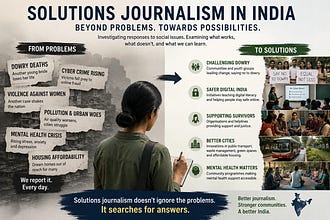
Looking Beyond the Headlines: Reimagining Civic Reporting
Reporting what works, why it works, and what others can learn. ( Water crisis in Mumbai)

Editor’s Note
Every city has its recurring headlines: water shortages, potholes, overflowing garbage bins, flooding, pollution, and traffic congestion. As journalists, we have a responsibility to report these issues and hold authorities accountable. But accountability doesn’t end with exposing problems—it also requires examining the responses.
Solutions journalism asks a different set of questions. Who is trying to solve the problem? What evidence shows the response is working? What challenges remain? And what can other communities learn from it?
In this edition, we explore how civic reporting can move beyond event-based coverage to produce stories that are rigorous, evidence-based, and useful to readers. Whether you’re a reporter covering your municipal corporation or a journalism student looking for story ideas, I hope these lessons encourage you to see your city differently.
— Vibha Singh
Mumbai does not have a rainfall problem. It has a rainwater management problem
The rain falling on Mumbai could help protect the city from its next summer crisis — if the city learns how to keep more of it.
As Indian cities face climate change, population growth, ageing infrastructure and erratic rainfall, water security will increasingly depend on how effectively communities capture, recharge, recycle and conserve water.
Every summer, Mumbai tells the same story. Reservoir levels decline. Water cuts are announced. Housing societies circulate advisories asking residents to conserve water. Car washing is restricted. Gardens receive less water. Families begin storing buckets and calculating how long their supply will last if the situation worsens.
This year, the warning signs arrived early. By mid-June 2026, Mumbai’s seven lakes had reportedly fallen to just over 10 per cent of their total capacity, leaving the city with around 40 days of water. The Brihanmumbai Municipal Corporation (BMC) responded with restrictions: water supply to construction sites was cut, industrial and commercial establishments faced reduced supply, and a citywide water cut was already in place
.
Then comes the contradiction. Within weeks, Mumbai will be drenched by one of the heaviest monsoons in the country. Roads will flood. Local trains may be disrupted. Stormwater drains will overflow. Millions of litres of freshwater will rush across concrete surfaces, through gutters and into creeks before finally disappearing into the Arabian Sea. Every year, Mumbai experiences two opposite realities. During the monsoon, the city struggles with excess water. During summer, it worries about having too little.
But these are not separate stories. They are the same story told in different seasons. As monsoon clouds gather over Mumbai once again, the question is no longer whether rain will arrive. The question is whether the city is prepared to keep it.
How can a city that receives more than 2,000 mm of rainfall annually struggle with water scarcity every summer?
For environmentalist and Mission Green Mumbai founder Subhajit Mukherjee, the answer is simple. “Mumbai does not have a rainfall problem. It has a rainwater management problem.”
That sentence should sit at the centre of Mumbai’s water debate.
The question is not only: where will Mumbai find more water?
The better question is: how much of the water Mumbai already receives is the city willing to keep?
A summer crisis and a monsoon opportunity
Most reporting on Mumbai’s water shortages focuses on the problem: declining lake levels, tanker dependence, delayed rainfall, water cuts and anxious residents. All of that matters. But solutions journalism asks a second question: who is responding, what are they trying, what evidence shows it is working, and what can others learn from it?
Across Mumbai, Thane and Navi Mumbai, residents, housing societies, environmental groups and water conservation experts are experimenting with practical ways to reduce dependence on external water sources.
Some are harvesting rainwater from rooftops. Some are recharging groundwater through borewells and recharge pits. Some are fixing leaks, reviving old wells, recycling wastewater and conducting water audits. Others are simply learning to measure how much water they use before asking for more. Individually, these interventions may look small. Together, they point towards a different model of urban water management. A city does not become water-secure only by building new dams. It also becomes water-secure by wasting less, reusing more and treating rain as an asset rather than a seasonal nuisance.
The household face of a citywide crisis
In many parts of Mumbai, water scarcity is not experienced as an abstract civic problem. It is experienced in kitchens, bathrooms, housing society meetings and early-morning queues.
In LIC colony in Borivali, residents say the first sign of a shortage is not always an official announcement. It is the change in routine. Tankers begin arriving more frequently. Garden watering is stopped. Domestic workers are asked to adjust timings. Residents on higher floors complain about low pressure. The society manager starts receiving calls before breakfast. Naresh More, resident of the area told, “This is not a new problem. Every year in month of April we face water cuts and tankers have to be called.”
For families in informal settlements, the pressure is often sharper. Water may come for a limited window. Storage space is limited. Women frequently manage the burden of collecting, rationing and planning household water use. Savitri Kamble, resident of P L Lokhande Marg in Chembur, “I get up at 4.00 am in the morning to fill water and then leave for work.”
This is why Mumbai’s water question cannot be reduced to lake levels alone. It is also about how water is distributed, stored, used, wasted and reused at the local level.
The water bank beneath our feet
One of the most practical ideas being promoted by conservationists is groundwater recharge through existing borewells and wells. Instead of allowing rooftop rainwater to flow directly into drains, buildings can channel filtered rainwater into recharge pits, recharge wells and borewells. The water then seeps underground, replenishing aquifers that can support local water needs during dry months. Mukherjee often compares this process to depositing money in a savings account. The monsoon becomes a period of saving. Summer becomes a period of withdrawal.
The small leaks that waste big volumes
Water scarcity is often discussed at the scale of dams, reservoirs and megaprojects. But some of the biggest opportunities lie much closer to home. Santy Shetty, founder of We All Connect and a Kandivali resident, has spent years educating residents about everyday water conservation. His focus is not only on big infrastructure, but on the ordinary points where water is lost: leaking taps, overflowing tanks, unattended valves and careless use.
“As we know, proper water management is necessary for the conservation of water. It is really essential that municipal bodies should take care of these issues while supplying water to our homes,” he says.
Shetty points to a common sight in housing societies: an overhead tank overflowing because someone forgot to close the valve. “In most housing societies, watchmen sometimes forget to close the valve and water tanks continue overflowing. As a result, there is huge wastage of water. We have been guiding people on how to save water, plug leaks and use water more effectively,” he says.
This may sound minor, but leaks add up quickly. A tap dripping once every second can waste thousands of gallons a year. In a city of millions, waste is not only a household issue. It becomes a civic issue. Every overflowing tank, broken pipe and dripping tap increases pressure on reservoirs, tankers and groundwater. Conservation, in this sense, is not a moral slogan. It is infrastructure. The cheapest litre of water is often the one that does not have to be pumped, treated, transported or replaced.
The wells Mumbai forgot
Another part of the solution may lie beneath Mumbai’s older neighbourhoods. Before municipal pipelines became widespread, local communities depended heavily on wells. Over time, many of these wells were covered, abandoned, polluted or forgotten as the city expanded and piped supply became the default. Today, some residents are trying to bring them back. In Borivali and Kandivali, local citizens have taken up the task of cleaning and maintaining old wells. One example is a nearly 200-year-old well discovered in 2017 in IC Colony, Borivali. It was later restored and beautified through local efforts.
Speak to local residents involved in the well restoration. Ask: Who found the well? What condition was it in? Who funded the cleaning? Is the water used today? Is it only symbolic, or does it help recharge groundwater?
Such wells will not solve Mumbai’s water crisis on their own. But they show how traditional infrastructure can complement modern conservation.
A revived well can become a local recharge point. It can reduce pressure on tankers. It can support non-potable uses. It can also remind a neighbourhood that water was once managed as a shared community resource, not only as something supplied invisibly through pipes. Mumbai does not need nostalgia. It needs memory with engineering.
The missing data problem
Mumbai already has rainwater harvesting rules. That is the uncomfortable part. Rainwater harvesting was made mandatory for new buildings on larger plots years ago, and the rules were later expanded to cover smaller plots as well. Yet reports have repeatedly pointed to weak enforcement and poor monitoring.
In one reported period, only around per cent of eligible new buildings had rainwater harvesting systems. This raises a basic question: if rainwater harvesting has been mandatory for years, why does the city still know so little about how many systems actually work?
A rainwater harvesting structure in a building file is not the same as a functioning system on the ground. Filters clog. Recharge pits silt up. Pumps fail. Tanks are not cleaned. Residents forget the system exists. In some buildings, rainwater harvesting is installed to satisfy approval requirements, but nobody is responsible for keeping it alive.
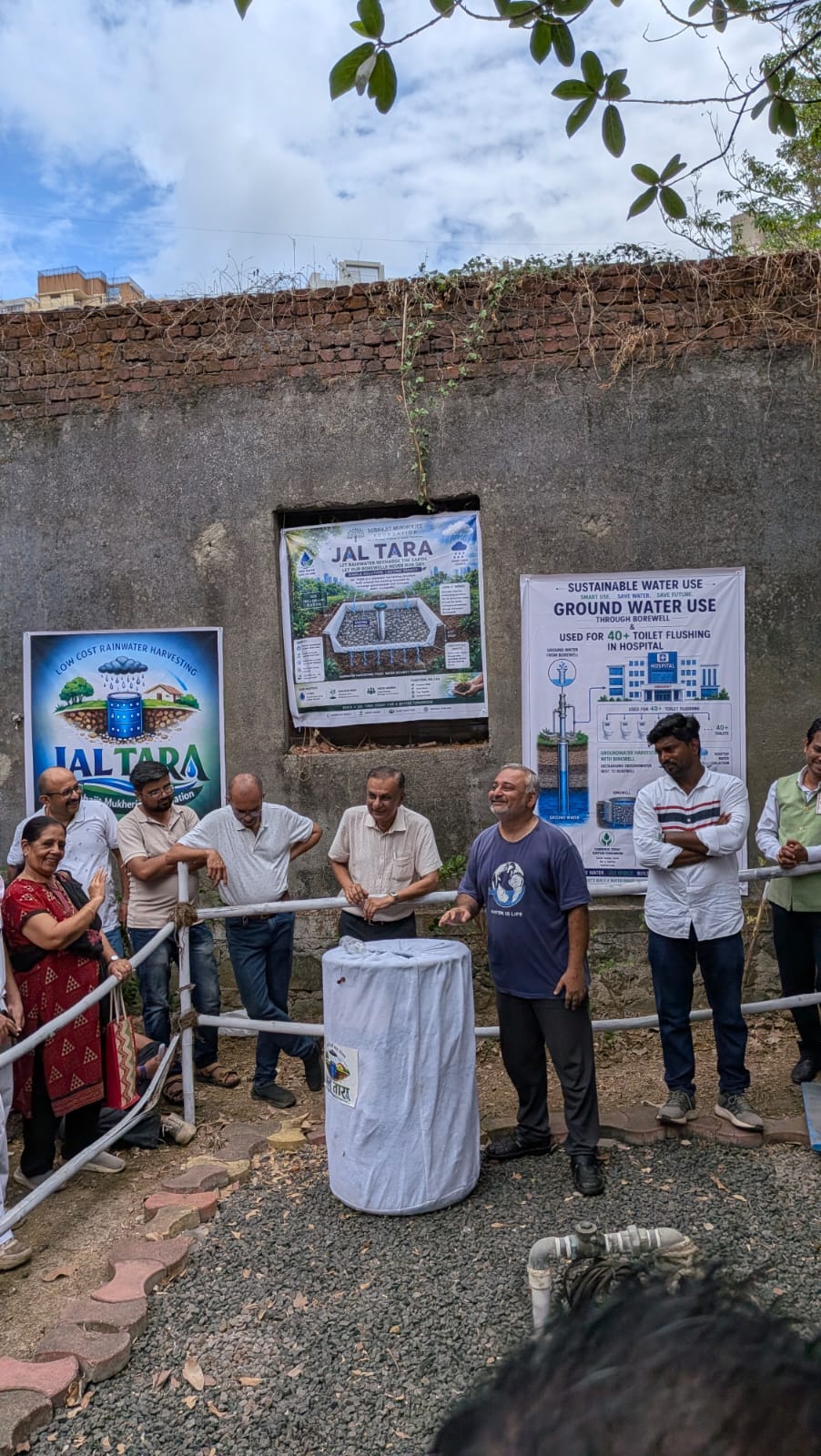
Citizens from across India participated in understanding the effects of El Nino on groundwater and rainwater harvesting and made a team nationwide to promote rainwater harvesting.
This is where Mumbai needs to move from installation to performance.
Every ward should know:
How many buildings have rainwater harvesting systems?
How many are functional?
How much water do they capture or recharge?
How often are they inspected?
How many societies have reduced tanker dependence?
How many systems have failed, and why?
Without this data, the city is flying blind. Rainwater harvesting cannot remain a line in a building approval file. It must become part of Mumbai’s water accounting.
When rainwater harvesting fails
Solutions journalism is not about pretending that every response works.
Rainwater harvesting can fail.
It fails when systems are badly designed. It fails when filters are not cleaned before the monsoon. It fails when recharge pits are built without understanding soil and groundwater conditions. It fails when storage tanks are contaminated. It fails when maintenance is nobody’s responsibility.
In coastal cities like Mumbai, there can also be concerns around salinity and groundwater quality. In dense neighbourhoods, space constraints can make large systems difficult. In older buildings, retrofitting can be expensive. In some societies, residents may not want to pay maintenance costs for a system whose benefits are not immediately visible.
Water conservation expert Subhash Reddy warns that rainwater harvesting systems should never be copied blindly. “Rainwater harvesting systems should be custom-made to suit the region, soil conditions and local geography,” he says.
That is important. A system that works in one neighbourhood may not work in another. Coastal areas may face salinity concerns. Older buildings may lack space. Some soils allow better infiltration than others. A recharge structure that is not maintained can clog, contaminate water or become useless within a few seasons. The lesson is clear: rainwater harvesting is not just a civil work. It is a local design problem, a maintenance problem and a governance problem.
These limitations matter. They do not weaken the argument for rainwater harvesting. They strengthen the case for doing it properly. The goal should not be to install more systems for the sake of numbers. The goal should be to create systems that are technically sound, locally appropriate and regularly maintained.
A failed rainwater harvesting system teaches us something too: water infrastructure cannot survive without accountability.
The equity question
There is another risk in the way urban water solutions are often discussed. They can become too focused on middle-class housing societies. Housing societies have rooftops, committees, maintenance funds and the ability to hire consultants. They can install meters, repair pipelines, build recharge pits and maintain sewage treatment plants.
But Mumbai’s water crisis is not experienced equally.
In informal settlements, families may depend on shared taps, irregular supply or private tankers. Women often bear the burden of storing, rationing and managing household water. Tenants may have little say in building-level infrastructure. In dense settlements, rainwater harvesting may be difficult because of unclear land tenure, narrow lanes and inadequate drainage. A citywide water strategy cannot ask only organised housing societies to act.
It must also ask: how can conservation work in slums, chawls, rental buildings, schools, hospitals, markets and public offices?
Public buildings should become demonstration sites. Schools can harvest rainwater. Municipal markets can reuse treated wastewater. Government offices can publish water-use data. Parks can become recharge zones. Public toilets can use recycled water where safe and feasible. If Mumbai wants water resilience, it cannot be a gated-society project. It has to be a public project.
What Mumbai can learn from Bengaluru and Varanasi
Mumbai does not have to look only abroad for ideas. Bengaluru’s “Million Wells” campaign, initiated by Biome Environmental Trust and water expert S. Vishwanath, aims to motivate citizens, communities, institutions and government bodies to dig, revive and maintain one million shallow recharge wells across the city. The campaign also recognises the knowledge of traditional well-diggers and links water security with livelihoods. The idea is powerful because it treats groundwater not as an invisible private reserve, but as a shared urban system.
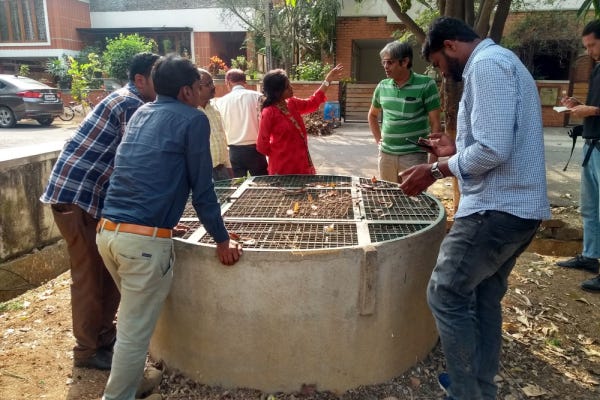
Bengaluru’s “Million Wells” campaign: Source: https://biometrust.org/our-work/
Varanasi offers another useful example. Under initiatives reported around IAS officer Himanshu Nagpal and local administration efforts, public buildings such as schools, colleges and government offices have been used as catchment points for rainwater harvesting and recharge. Reports have described more than 1,000 public buildings being equipped with rooftop rainwater harvesting systems, alongside pond restoration and recharge initiatives.
The lesson for Mumbai is clear: when private compliance is weak, public property can become a major catchment area. Mumbai has schools, hospitals, railway buildings, municipal offices, markets, gardens, bus depots and large public campuses. Each of these can either shed rainwater into drains or help return it to the ground. The city should not wait for every private building to act before using its own public infrastructure better.
Learning from the world
Mumbai is not alone. Around the world, cities facing water stress have shifted from simply finding new sources to managing existing water more intelligently.
Singapore is one of the strongest examples. With limited natural freshwater resources, it built a system around its “Four National Taps”: local catchment water, imported water, desalinated water and NEWater. NEWater recycles treated used water into ultra-clean, high-grade reclaimed water, helping cushion supply during dry weather. The lesson is that wastewater should not be treated as waste. Treated water can be reused for flushing, gardening, construction and industrial use, reducing demand for freshwater.
Israel has become a global leader in wastewater reuse. According to the OECD, more than 87 per cent of Israel’s wastewater effluent is reused for agricultural irrigation The lesson for Indian cities is simple: water used once does not have to be discarded.
Cape Town offers a different lesson. During its 2018 “Day Zero” crisis, the city faced the possibility that municipal taps could run dry. The Day Zero threshold in Cape Town was set at 13.5 per cent of usable dam storage. The city avoided that outcome through strict restrictions, public communication, reduced consumption and monitoring. Here what is important for people change behaviour when they understand the seriousness of a crisis and can see measurable results.
The Netherlands, especially cities such as Rotterdam, shows how flood management and urban design can work together. Water plazas and blue-green infrastructure are designed to temporarily hold rainwater during heavy showers and release it slowly later.
The lesson for Mumbai is especially relevant: flood control and water conservation should not be treated as separate problems. The same rain that floods the city can also recharge it.
The India Solutions Desk take
Mumbai receives enough rain to make its summer water anxiety feel like a failure of imagination. This does not mean every drop can be captured. It cannot. Some rain will flood. Some will run off. Some systems will fail. Some neighbourhoods will need different solutions. Rainwater harvesting alone will not solve Mumbai’s water crisis.
But that is not the point. The point is that Mumbai is still wasting too much of the water it already receives.
The experiences of housing societies, River March activists, water conservation groups, well-revival efforts and other Indian cities suggest that resilience does not come only from increasing supply. It also comes from managing what already exists.
This lesson extends far beyond Mumbai. Because the most important lesson from Mumbai’s own water warriors, from Bengaluru’s wells, from Varanasi’s public buildings, from Singapore’s NEWater, from Cape Town’s Day Zero and from Rotterdam’s water plazas is this:
Cities that manage water well are not necessarily the ones with the most water. They are the ones that waste the less
Reporting Note
Lesson 1: How to cover civic Issues Through a Solutions Journalism Lens
Most civic stories focus on what’s broken—water shortages, flooding, garbage, traffic, or pollution. Solutions journalism goes a step further and asks: Who is responding, how does the response work, and what evidence shows it is making a difference?
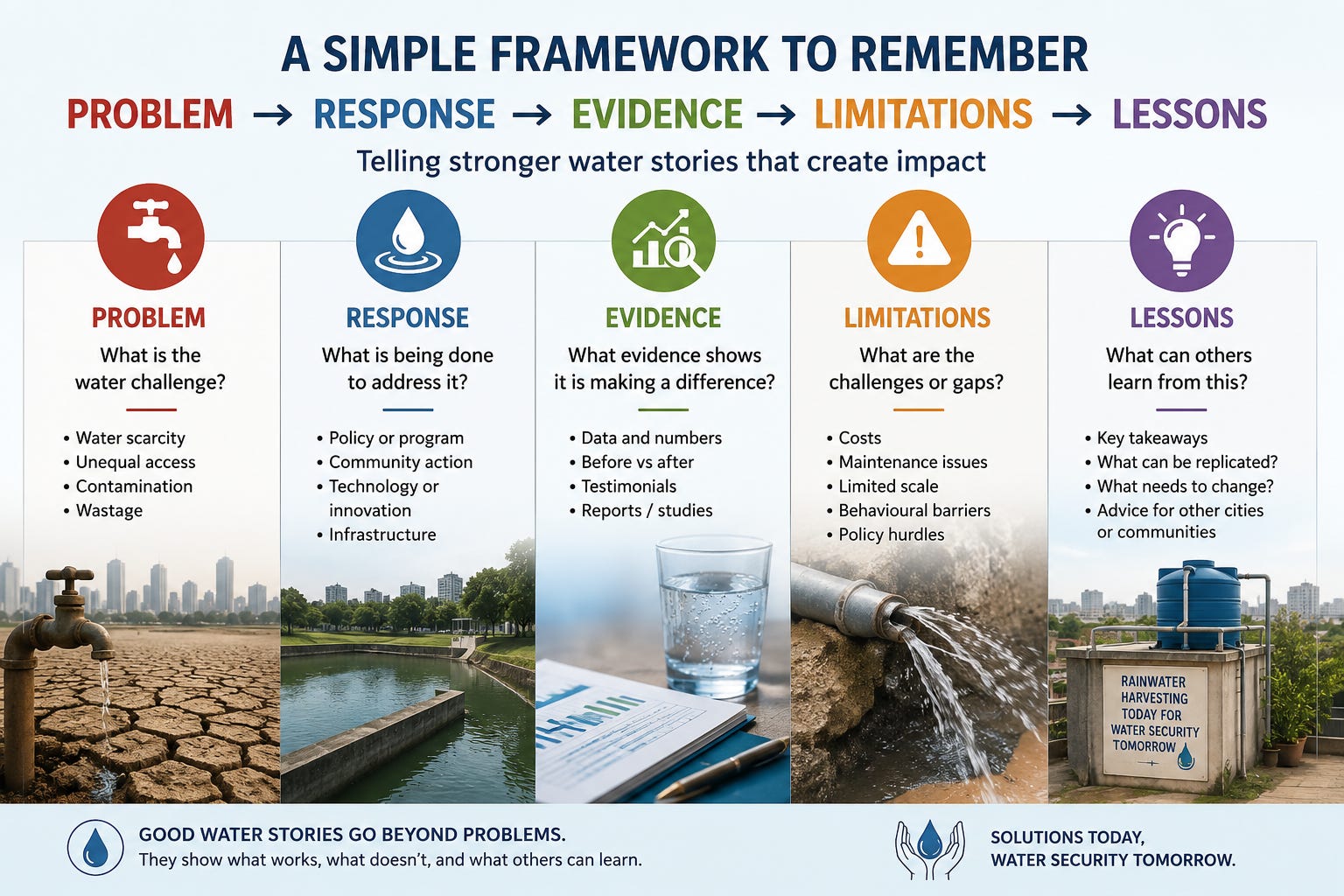
When reporting on civic issues:
Start with the problem, but don’t stop there.
Look for people, communities, institutions, or local governments trying to address it.
Examine how the response works and whether it is producing measurable results.
Use data, not just claims, to assess impact.
Speak to residents first, then officials and experts.
Be honest about limitations, costs, and challenges.
End with lessons that other communities can learn from.
© 2026 [Vibha Singh]. All rights reserved